
Is technology the engine or the brake of your growth?
All standard platforms (SaaS) have limits. When a business reaches the technology ceiling, software rigidity starts costing money, time, and opportunities.

If you lead the business…
If you lead technology…
If you lead operations or finance…
Crombie’s Blend Model
Breaking the technology ceiling of retail operations.
We combine the stability of retail and ecommerce platforms with the flexibility of custom development.
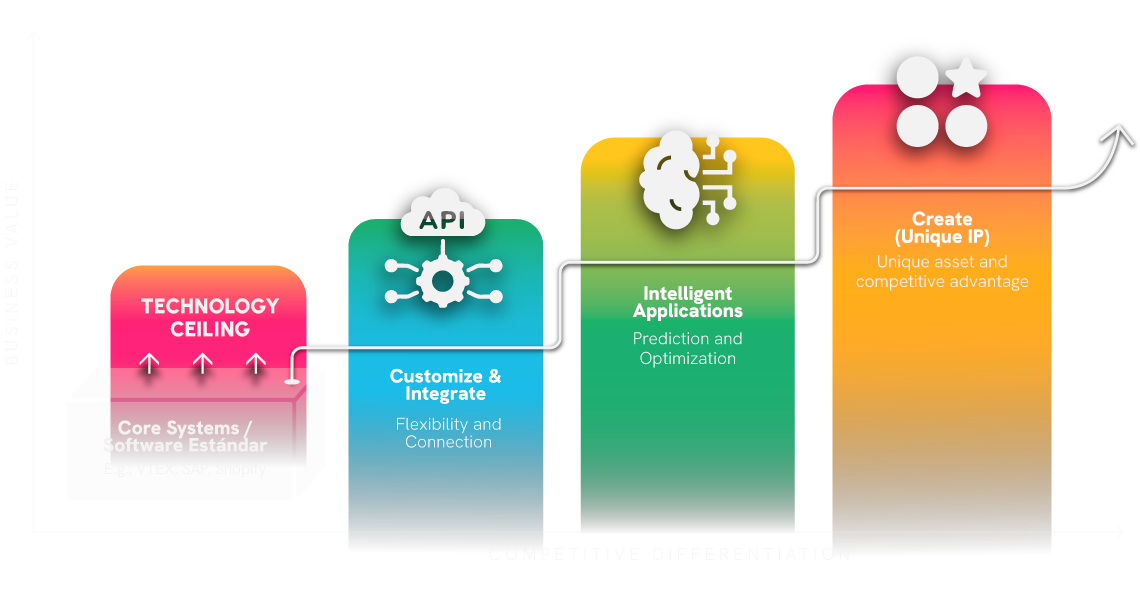
Intervention Layers

Layer 1: Customization and Integration
We connect ecosystems to eliminate silos and ensure operations flow seamlessly.

Layer 2: Intelligent Applications
We implement AI and Machine Learning to anticipate demand and personalize offers in real time.
We implement AI and Machine Learning to anticipate demand and personalize offers in real time.

Layer 3: Proprietary IP Creation
We build disruptive capabilities that the market does not offer, ensuring ownership of innovation.


How do we start transforming operations?
Scale-Up Assessment

A program to align technology and operations with customer experience and profitability.
Custom Solution Build
Development and integration of tailored solutions for retail and ecommerce companies.
Crombie Success Stories
Discover how we helped companies break their technological ceiling in retail and ecommerce.


 Can Crombie integrate with ERP, OMS, WMS, and existing systems?
Yes. Integrating critical systems is one of our core capabilities to eliminate silos and improve end-to-end operations.
 What limits scalability in retail and ecommerce?
Primarily the lack of integration between channels, processes, and systems. Operational and technological silos ultimately impact costs, timelines, and customer experience.
 How does software development improve operations in retail companies?
Software development for retail helps optimize operations such as inventory management, ecommerce platforms, and customer experience. By building integrated digital systems, retailers can connect physical stores with online channels, automate processes, and gain better visibility across operations. This improves efficiency, reduces operational friction, and allows retailers to deliver more consistent customer experiences across all sales channels.
 Why do retail companies need custom software solutions?
Retail companies often operate with multiple systems such as ecommerce platforms, inventory tools, ERP systems, and logistics services. Custom software solutions allow these systems to integrate efficiently and adapt to the specific needs of the business. Unlike generic SaaS tools, custom platforms can scale with the company’s operations and support complex omnichannel retail strategies.
How does artificial intelligence help the retail industry?Artificial intelligence helps retailers analyze customer behavior, predict demand, and optimize pricing strategies. AI can also improve product recommendations, automate customer service, and detect purchasing patterns across channels. By leveraging AI-powered insights, retailers can improve operational efficiency while delivering more personalized experiences to customers.
What technologies power modern ecommerce platforms for retailers?Modern ecommerce platforms typically rely on cloud infrastructure, microservices architectures, and API-based integrations. These technologies allow retailers to connect payment systems, inventory management tools, and logistics platforms while maintaining scalability. A modern technology stack enables retailers to support high traffic, integrate new services quickly, and expand their digital capabilities.
How can retailers optimize their technology stack effectively?Optimizing a retail technology stack involves evaluating existing systems, eliminating redundancies, and improving integrations between platforms. Retailers often modernize their infrastructure to reduce operational costs and improve performance. By adopting scalable architectures and better integrations, companies can build a technology foundation that supports long-term growth.
How can ecommerce platforms integrate with inventory and ERP systems?Integration typically occurs through APIs and middleware solutions that connect ecommerce platforms with ERP, inventory, and logistics systems. This allows retailers to synchronize stock levels, orders, and customer data in real time. Proper integrations help avoid inventory inconsistencies and improve operational efficiency across retail operations.
What benefits does automation bring to retail operations?Automation helps retailers reduce manual work, increase operational accuracy, and improve efficiency across business processes. Automated systems can manage inventory updates, order processing, marketing campaigns, and customer interactions. By automating repetitive tasks, retailers can focus on strategic initiatives while maintaining more reliable operations.
How can technology improve the customer experience in retail?Retail companies use technologies such as AI, data analytics, and omnichannel platforms to enhance customer experiences. These tools help personalize product recommendations, streamline checkout processes, and unify interactions across physical and digital channels. Technology enables retailers to deliver consistent, personalized experiences that strengthen customer loyalty.
When should a retail company build custom software solutions?Retail companies should consider custom software when they need to integrate multiple systems, modernize their technology stack, or build scalable digital platforms. Custom development allows retailers to design solutions aligned with their operational workflows and business goals, supporting long-term scalability and competitive differentiation.
How do you choose a technology partner for retail software development?Choosing a technology partner for retail software development requires evaluating experience with ecommerce platforms, complex integrations, and scalable architectures. A specialized partner understands challenges like omnichannel operations, inventory systems, and customer experience. Companies such as Crombie, focused on custom software development, help retailers modernize their infrastructure and build scalable digital platforms.
How long does it take to implement a retail technology platform?Implementation timelines depend on project scope, integrations, and system complexity. Many retailers begin with a minimum viable product (MVP) to validate core capabilities before expanding functionality. This approach allows companies to launch faster while