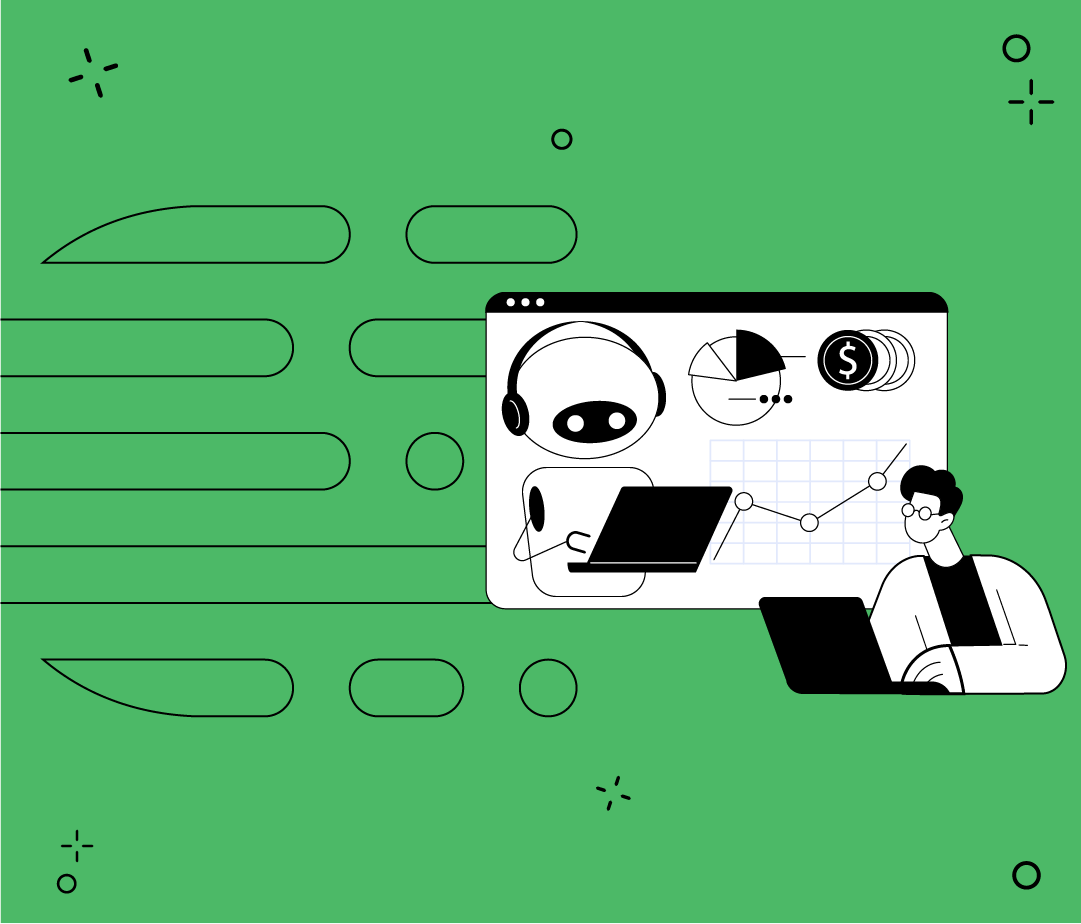
More Than an AI Chatbot, a Technology That Unlocks Your Potential

30 %
reduction in process management time thanks to automation
IBM, 2023

25 %
improvement in customer satisfaction with intelligent assistance
Atento, 2024

60 %
decrease in the operational workload of support teams
McKinsey, 2024


What is an AI Agent?
It’s a Generative AI solution capable of understanding, responding, and performing tasks in real time. Unlike traditional virtual assistants, the Artificial Intelligence Agent doesn’t follow fixed rules: it understands context, learns from users, and acts autonomously.
Additionally, the AI Agent is agnostic; meaning it can be implemented in any company or industry.
Key Capabilities of the AI Agent

Written and Spoken Natural Language Understanding
Interprets user intent and adjusts tone based on context, delivering clear and accurate responses.

Automation of Complex Tasks and Workflows
Executes actions such as ticket management, report generation, or CRM data entry—reducing manual effort.

Information Extraction from Documents and Databases
The AI Chat analyzes documents, emails, and databases to provide real-time information and enhance decision-making.

24/7 Personalized and Contextual Support
This AI answers questions; guides onboarding processes, and resolves issues with a seamless, human-like experience.

Omnichannel Support with Integration Across WhatsApp, Slack, Email, and More
Unlike Cliengo, Crombie’s AI Agent centralizes communication without switching tools, delivering a consistent user experience.

Brand-Aligned Communication
Delivers a conversational style that’s consistent with your brand’s voice and tone.

Multilingual
Engages in multiple languages with high precision—ideal for global organizations and distributed teams.

Why adopt AI with Crombie?
 Measurable impact in less than 30 days
We accelerate the implementation process, validating the technology with a pilot (PoC) in just a few weeks.
 Lower costs and faster delivery
We avoid building from scratch, significantly reducing implementation time and costs.
 Empathy-Driven approach
Unlike other providers such as Cliengo, Zendesk, or Globant, at Crombie we align technology with your company’s specific needs and goals.
 20 years of experience
For two decades, we’ve been driving business growth through solid and scalable solutions.
Frequently Asked Questions About Crombie’s AI Agent
What types of AI agents does Crombie offer?At Crombie, we design agnostic AI agents tailored to real use cases. We can implement AI agents for sales, customer support, technical support, internal operations, code review, and more.
How Much Does an AI Agent Cost?It depends on the type of agent, its complexity, and the level of integration required. Each project is evaluated based on your company’s goals. Contact our team for a personalized proposal.
How Does an Intelligent Agent Work?An Artificial Intelligence Agent combines language models, reasoning, and action. It interprets text or voice inputs, accesses internal systems, and performs tasks via APIs or integrations.
What is the best AI Agent?There are many options on the market; however, Crombie’s AI agent stands out by combining generative AI, contextual understanding, and deep integration with enterprise systems.
How long does it take to implement an AI agent in a company?Thanks to our business‑focused approach, it’s possible to see measurable results in under 30 days.
What is the difference between a chatbot and an AI agent?The difference lies in reasoning capabilities and autonomy. While a traditional chatbot operates with rigid decision flows and predefined responses, an AI agent uses advanced language models to understand ambiguous contexts and execute complex tasks. An agent doesn’t just respond—it processes intent and can interact with external tools to solve problems dynamically and naturally.
How does NLP work in an advanced conversational agent?NLP in advanced agents uses neural network architectures called Transformers to analyze the semantics and context of each sentence. This process converts human language into mathematical vectors that AI interprets to identify not only words but also sentiment and user intent. This enables fluid communication, where the agent can handle slang, grammatical errors, and topic shifts without losing context.
What are the main benefits of automating customer support with AI agents?The main benefits are operational scalability and always-on availability. AI agents can resolve up to 80% of frequently asked questions instantly and in multiple languages, eliminating wait times. This frees human teams to focus on high-complexity cases, reducing cost per ticket and significantly improving CSAT (Customer Satisfaction Score) through precise and personalized support.
What does it mean for an AI agent to be elastically scalable?Elastic scalability refers to the agent’s ability to handle thousands of simultaneous interactions without degrading speed or response quality. Unlike traditional contact centers, whose capacity is limited by available staff, a cloud-based AI agent can absorb massive demand spikes (such as Cyber Monday or financial launches) while maintaining consistent and efficient performance.
Is it possible to integrate an AI agent with systems such as CRM or ERP?Yes, integration is key for an agent to move from informing to executing. Through APIs and modular service layers, AI can connect with systems like Salesforce, SAP, or HubSpot to retrieve order statuses, balances, or customer history in real time. This design ensures the agent becomes a functional extension of operations, capable of updating databases and personalizing interactions based on user profiles.
How does response latency impact AI adoption rates?Latency is a critical factor in user experience; slow responses can be perceived as system failure. Optimizing infrastructure and selecting the appropriate inference model is essential to balance reasoning complexity with response speed. A well-designed architecture ensures millisecond-level responses, maintaining user engagement and perceived efficiency.
How can an AI agent maintain brand consistency and tone of voice?Consistency is ensured through advanced system prompt design and the use of reference examples (few-shot prompting). By defining strict guidelines around personality and boundaries, every response aligns with corporate values. Crombie applies validation methodologies to ensure that even under ambiguous queries, the agent responds with the professionalism and precision required by the business.
When is fine-tuning necessary versus a RAG implementation?Fine-tuning is recommended when the agent needs to learn highly specific technical language or a unique communication style, while RAG is ideal for keeping the agent updated with frequently changing data. In most enterprise solutions, combining both approaches results in an agent that deeply understands brand identity while accessing real-time operational information with high accuracy.
How can you ensure an AI agent does not generate hallucinations or incorrect responses?Hallucination mitigation is achieved through grounding techniques and the implementation of RAG architecture, which restricts the model to retrieving answers only from verified data sources. Additionally, technical validation layers and safety guardrails are configured to monitor outputs. This ensures that if information is not available in the knowledge base, the agent acknowledges it instead of generating incorrect responses.
What is the estimated time to train and deploy a conversational agent using proprietary data?An initial deployment under an MVP (Minimum Viable Product) model typically takes between 3 and 5 weeks. This timeframe includes ingesting corporate data, configuring the search infrastructure, and integrating with preferred communication channels (WhatsApp, web, or app). This agile approach allows for real-world validation and iterative improvements based on user behavior.
How is user data privacy ensured in AI interactions?Privacy is ensured through end-to-end encryption, anonymization of sensitive data, and strict compliance with regulations such as GDPR and corporate cybersecurity standards. By using private cloud environments or controlled instances, conversations are not used to train public third-party models. Information security is a core architectural pillar to protect both intellectual property and customer identity.
How is ROI measured after implementing an enterprise AI agent?ROI is measured through reductions in operational costs, savings in human effort, and increases in first contact resolution (FCR). Indirect metrics such as increased sales due to 24/7 availability and improved customer retention are also considered. By comparing implementation costs with efficiency gains, organizations typically see a positive return within the first six months, turning AI into a driver of financial efficiency.