


Where Is Your Loan Cycle Losing Time and Revenue?
In the US, lending operations rely on an ecosystem of core systems, SaaS platforms, APIs, data sources, and specialized providers. When these pieces don’t work together as an integrated flow, every interaction between systems adds friction.
Manual validations, fragmented information, and disconnected decisions extend the time between application and funding, impacting conversion, operational efficiency, CAC, and Time-to-Cash.
That’s where Crombie comes in: we connect systems, data, and decisions to eliminate bottlenecks, automate critical workflows, and accelerate the lending cycle, without replacing the technology that already works.
Blend Model: We Enhance What You Have and Build What You’re Missing
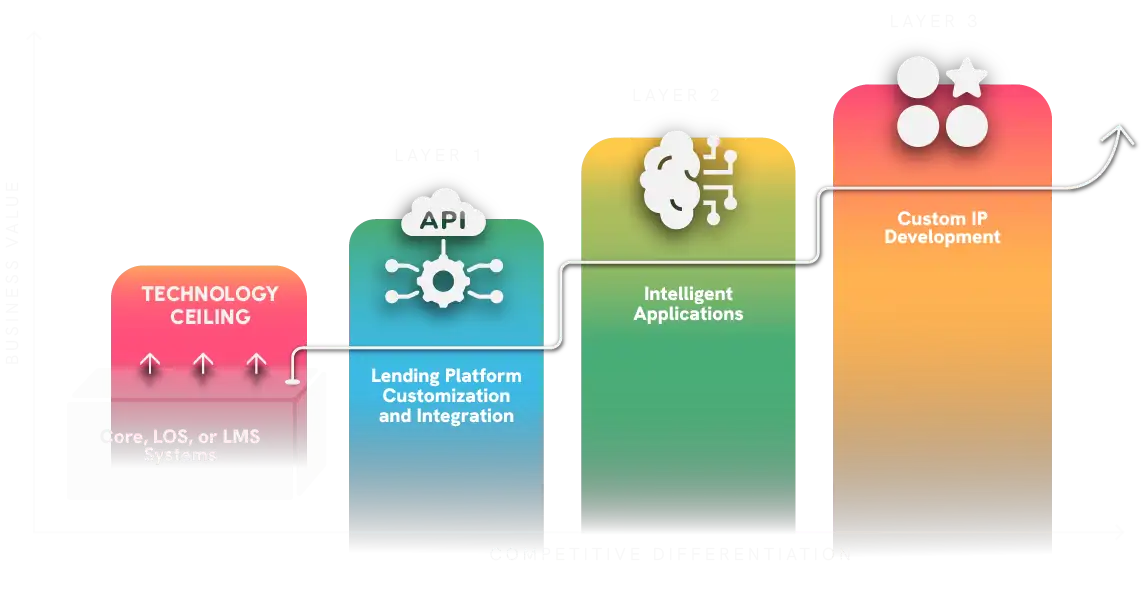

Layer 1: Lending Platform Customization and Integration
We connect your core, SaaS platforms, APIs, data sources, and providers so they work as part of a single flow.

Layer 2: Intelligent Applications
We incorporate automation and AI to reduce manual tasks, speed up analysis, and support decision-making throughout the lending cycle.

Layer 3: Custom IP Development
We develop specific logic and capabilities for the processes and rules that off-the-shelf solutions can’t handle.
We Build Custom Solutions for Your Lending Challenges
We turn the most recurring problems in the loan cycle into reusable solutions that speed up implementation and reduce risk.
AI-Driven Underwriting Engine

How many customers are you losing to manual origination?
We automate underwriting with AI and real-time data to verify income, identity, and eligibility in minutes.
Agentic Broker Reconciliation
How many hours does your team spend reconciling broker commissions?
An AI agent reconciles payments between lenders and brokers, flags discrepancies, and validates complex commission structures.
Multi-State Smart Pricing Layer
Does your team rely on IT to change a rate or a fee?
We decouple pricing from the core so your business team can adjust rates and fees by state in real time.
HELOC DTI Optimizer
How many HELOCs are you declining due to rigid eligibility rules?
We recalculate DTI in real time, factoring in debt consolidation and co-borrowers, to recover applications that are currently being lost.
Automated Denial Monetization
How much CAC are you losing with every applicant you decline?
We automatically route declined applications to compatible partners and turn rejected leads into revenue.
Payout Orchestrator
Are your broker and funder payouts still living in Excel?
We orchestrate the distribution of funds among brokers, funders, and insurers based on payment priority rules.
Fintech success works
Discover how we drive the growth and innovation of companies with fintech software solutions.



 Why does the lending cycle take so long between application and funding?
The lending cycle gets longer because origination relies on an ecosystem of systems that don’t work as a single flow: core, LOS, SaaS platforms, APIs, and data sources. Every handoff between them adds manual validations and fragmented information, which extend the time to funding and increase drop-off among qualified applicants.
 What is Time-to-Cash in lending and why does it affect profitability?
Time-to-Cash in lending is the time between when an applicant starts a loan application and when they receive the funds. The longer it is, the more applicants abandon the process, the higher the CAC, and the longer it takes the company to generate revenue. That’s why it’s one of the metrics with the greatest impact on a lender’s profitability.
 What is AI-powered automated underwriting in lending?
AI-powered automated underwriting is a credit assessment process that verifies an applicant’s income, identity, and eligibility in minutes through integrations with real-time data sources. In lending, it replaces manual validations and rigid models, while critical decisions retain human oversight and explainability for audit purposes.
 What is broker commission reconciliation in lending?
Broker commission reconciliation in lending is the process of matching the funds sent against each broker’s reports to detect discrepancies in payments and fees. When done manually, it eats up hours of back-office time, delays the operational close, and strains the relationship with the indirect channel, especially when each broker has a different commission structure.
What is DTI and how does it affect HELOC approval?DTI (debt-to-income) is the ratio between an applicant’s monthly debt payments and their income, and it’s one of the key criteria for approving a HELOC. When it exceeds the policy limit, many systems automatically decline the application, even though the customer could qualify by consolidating debt or adding a co-borrower.
Should you choose an off-the-shelf LOS or custom development for lending?An off-the-shelf LOS makes sense when the origination process is standard; custom development is the better fit when the lender operates with its own rules, across multiple states, or with integrations the product doesn’t cover. In those cases, the LOS usually leaves manual validations outside the system. Specialized companies like Crombie build custom lending software that integrates with the existing LOS and extends what it can’t handle.
Do you need to replace your core or LOS to automate lending operations?No, automating lending operations doesn’t require replacing your core or LOS. New capabilities, such as automated underwriting, decoupled pricing, or broker reconciliation, are built around existing systems and connect to them via APIs. Replacing them only makes sense when they can no longer support business growth.
How can a lender approve more loans without increasing risk?A lender can approve more loans without increasing risk by bringing more data into underwriting and recalculating eligibility before declining an application. Verifying income with real-time sources and offering alternatives, such as debt consolidation or adding a co-borrower, makes it possible to recover creditworthy applications that a rigid model would reject.
How can declined loan applications be monetized?Declined loan applications can be monetized by automatically routing them to compatible lending partners, without the applicant having to repeat onboarding. This allows the lender to recover part of the CAC invested in each lead and create a new revenue stream, without changing its own risk policies.
How can you manage rates and fees across multiple states without relying on IT?To manage rates and fees across multiple states without relying on IT, pricing logic is decoupled from the core and moved to a dedicated layer that the business team manages in real time. As a result, a state-level rate change no longer requires a development and deployment cycle, and the lender can respond faster to market conditions.
How much does custom lending software development cost?The cost of custom lending software development depends on the number of systems to integrate, the states where the lender operates, and whether a reusable solution already exists for that problem. Starting from pre-built solutions, such as an underwriting or reconciliation engine, reduces the scope compared to building from scratch. An initial assessment is needed to provide an estimate.
How long does it take to implement a custom lending solution?Implementation time for a custom lending solution depends on two factors: how many systems need to be integrated and how complex the process to automate is. Since it’s built on top of the existing core and LOS, there’s no need to wait until everything is ready: you can start with the bottleneck that has the greatest impact on Time-to-Cash and add the rest in phases.
What results can you expect from automating lending processes?When automating lending processes, results typically show up in three metrics: shorter Time-to-Cash, more approved applications, and fewer hours of manual work on validations and reconciliations. The specific impact depends on the chosen process and each lender’s starting point, so it’s best to define the metric you want to move before development begins.
How do you choose a lending software development provider in the US?When choosing a lending software development provider in the US, it’s worth evaluating their experience in origination and underwriting, their ability to integrate with your LOS without replacing it, and their proven track record. Crombie, for example, built a platform for NFTYDoor that cut HELOC funding time from 30 to 5 days, and helped Skylight Lending increase its conversions by 50%.