



AI customer service usually arrives when the support team can no longer keep up. Response times grow, and every new customer adds cost. That is why more companies are deploying an AI customer service agent. However, many soon find a new problem: the agent answers, but customers keep coming back with the same issue. An AI agent is measured by what it resolves, not by what it answers.
That difference has a name: First Contact Resolution (FCR), the percentage of issues resolved in the first interaction. It is also the condition behind the market's biggest promise.
In 2025, Gartner, https://www.gartner.com/en/newsroom/press-releases/2025-03-05-gartner-predicts-agentic-ai-will-autonomously-resolve-80-percent-of-common-customer-service-issues-without-human-intervention-by-20290?utm_term=1742993448&utm_campaign=SM_GB_YOY_GTR_SOC_SF1_SM-PR-GBS-CSS&utm_source=linkedin,threads predicted that agentic AI will autonomously resolve 80% of common customer service issues by 2029. According to the firm, that would mean a 30% reduction in operational costs. But only if the agent actually resolves.
In this Crombie article, you will learn what First Contact Resolution is and how to calculate it. You will also see why low FCR multiplies costs when AI agents are involved. Finally, you will learn how to prepare your customer service before demand grows.
What Is First Contact Resolution (FCR) and How Do You Calculate It?
First Contact Resolution (FCR) is the percentage of customer issues resolved in the first interaction. To calculate it, divide the issues resolved on first contact by the total issues received, then multiply by 100. The metric started in call centers, but it now applies to every channel, including AI customer service.
First Contact Resolution rate = (issues resolved on first contact ÷ total issues received) × 100
For example, if a company receives 2,000 inquiries in a month and resolves 1,500 on first contact, its FCR is 75%. For the number to be meaningful, both figures must cover the same period.

Differences Between First Contact Resolution and First Call Resolution
The two terms are often used interchangeably. First call resolution is tied to the phone channel, the traditional call center setting. First Contact Resolution, on the other hand, covers chat, email, messaging apps, and every digital channel. That is why, when AI agents are involved, First Contact Resolution is the more accurate term.
What Is a Good First Contact Resolution Rate?
According to SQM Group, a First Contact Resolution rate between 70% and 79% is a good industry standard. A rate of 80% or higher is considered world-class. However, only about 5% of call centers reach that level.
That First Contact Resolution benchmark, however, measures the total FCR of an operation. In other words, it includes issues resolved by people and issues resolved by an AI agent. Comparing the agent alone against that number is a common mistake. That is why you should separate your metrics before setting AI customer service goals.
FCR vs. Containment Rate vs. Deflection Rate: What Each Metric Measures
First Contact Resolution measures whether an issue was resolved on first contact. Containment rate measures whether the conversation ended without a request for a human. Autonomous resolution rate measures how much the AI agent resolves on its own. Confusing these metrics is the fastest way to overestimate an AI agent.
Metric | What it measures | What it doesn't measure | Risk if used alone |
First Contact Resolution (FCR) | Issues resolved on first contact, by any means | Who resolved the issue | Hides how much the agent contributes |
Containment rate | Conversations not escalated to a human | Whether the issue was actually resolved | A customer who gives up counts as "contained" |
Deflection rate | Inquiries that never reach the human team | Whether the customer returned through another channel | Measures diverted volume, not resolution |
Autonomous resolution rate | Issues the AI agent resolves without human intervention | The quality of escalations | Can be inflated by trivial inquiries |
When evaluating AI customer service, containment rate is the most misleading metric. A frustrated customer who closes the chat still counts as a contained conversation. But if that customer then calls, emails, or abandons the purchase, the issue remains open. That is why high containment with low First Contact Resolution is a warning sign, not a win.
This is the lens for setting goals for an AI customer service agent. In Crombie's experience, a well-trained agent resolves about 60% of inquiries on its own. The rest is escalated to people who, with full context, can also resolve on first contact.
What customer service processes could an AI agent resolve?
Get Crombie's free ebook and learn how to implement a conversational AI agent to optimize customer service.
Why Low First Contact Resolution Multiplies Costs with AI Agents
Low First Contact Resolution multiplies costs because every unresolved issue is paid for more than once. In AI customer service, each repeat contact also consumes processing, tokens, and infrastructure. And if the issue is escalated, the cost of the human team is added on top.
SQM Group estimates that every 1% improvement in FCR reduces operating costs by 1%. The logic is simple: fewer repeat contacts mean less handling time per issue.
The Hidden Cost of Repeat Contacts in AI Customer Service
When an issue isn't resolved on first contact, a chain of costs begins:
- the customer starts a new conversation, and the agent processes the context again;
- each new interaction consumes model tokens and cloud infrastructure capacity;
- if the case is escalated, a person picks it up, often without the full history;
- the customer loses trust and, in some cases, abandons the purchase.
In cloud architectures such as AWS, that consumption shows up directly on the monthly bill. That is why cost per contact rises even when the agent looks busy and productive. To go deeper into that technical layer, read our article on how to scale AI agents in production.

Why You Should Prepare AI Customer Service Before You Scale
When a company grows, inquiry volume grows faster than the team. Growth can come from an ad campaign, a peak season, a product launch, or a new channel. If the AI agent doesn't resolve issues well yet, that extra volume turns into repeat contacts, escalations, and costs. By contrast, an agent prepared in advance absorbs demand without overwhelming your people.
Many companies scale first and fix customer service later. The result is predictable: overloaded teams, long response times, and customers who don't come back. Every unresolved inquiry is also a lost sales opportunity. In a paid campaign, it is also a click you paid for that never converted.
Before a demand peak, make sure your AI customer service agent:
- resolves the most frequent inquiries that growth will generate;
- accesses the data it needs, such as inventory, pricing, appointments, or order status;
- escalates to a person with the full conversation context;
- has its First Contact Resolution rate measured with real volume, not just in testing;
- offers 24/7 support in the channels where inquiries arrive, such as chat, messaging, or your website.
Peak season, product launch, or campaign coming up?
Before demand grows, check whether your customer service is ready for that volume. Tell us about your case, and we'll help you find where inquiries are slipping through.
How to Measure First Contact Resolution for an AI Agent
In AI customer service, you measure First Contact Resolution by confirming that the customer didn't return for the same reason. To do that, define a repeat-contact window and cross-reference data from every channel. You should also validate resolution with the customer.
- Define the repeat-contact window: This is the period in which a new contact about the same issue counts as unresolved. Its length depends on the inquiry type: booking an appointment is not the same as filing a complaint.
- Cross-reference every channel: If a customer writes in chat and then calls, it is the same case. Measuring each channel separately inflates FCR, because the repeat contact falls outside the count.
- *Validate resolution with the customer: *A short closing question, such as "Did we resolve your issue?", adds the customer's perspective. Combined with repeat-contact data, it produces a much more reliable measurement.
- Separate autonomous and escalated resolution: Finally, report what the agent resolves separately from what the team resolves. That way, you can tell whether the problem lies in the agent or in the escalation.
First Call Resolution Best Practices for AI Customer Service Agents
To improve First Contact Resolution, an AI agent needs real data, the ability to take action, and good escalation. Most unresolved issues don't fail because of the model. They fail because of what the agent can't see or can't do.
- Connect the agent to your business systems: CRM, ERP, inventory, scheduling, or order status. Without data, the agent can only give generic answers.
- Give it the ability to act: Informing is not enough: it has to book, reserve, update, or cancel.
- Train it on real inquiries: Historical conversations show what customers ask and how they ask it.
- Design the handoff to people: The handoff must include the full history, so the customer doesn't repeat everything.
- Review repeat contacts every week: Every issue that comes back shows what the agent is missing.
Specialized software development companies, such as Crombie, build custom AI agents integrated with each business's systems. That level of integration is what lets AI customer service resolve issues, not just answer them. To see what other tasks you can delegate, read our article on AI agents.

AI Customer Service Examples
The most cited AI customer service cases show a pattern. The ones that work measure resolution, integrate data, and keep a path to people. The ones that fail focus only on automating volume or cutting costs.
The risk is real. According to a 2024 Verint survey, more than two-thirds of consumers had a bad chatbot experience. Their top complaint was that the chatbot couldn't answer their questions.
AI Agents in Fintech: Klarna and 25% Fewer Repeat Inquiries
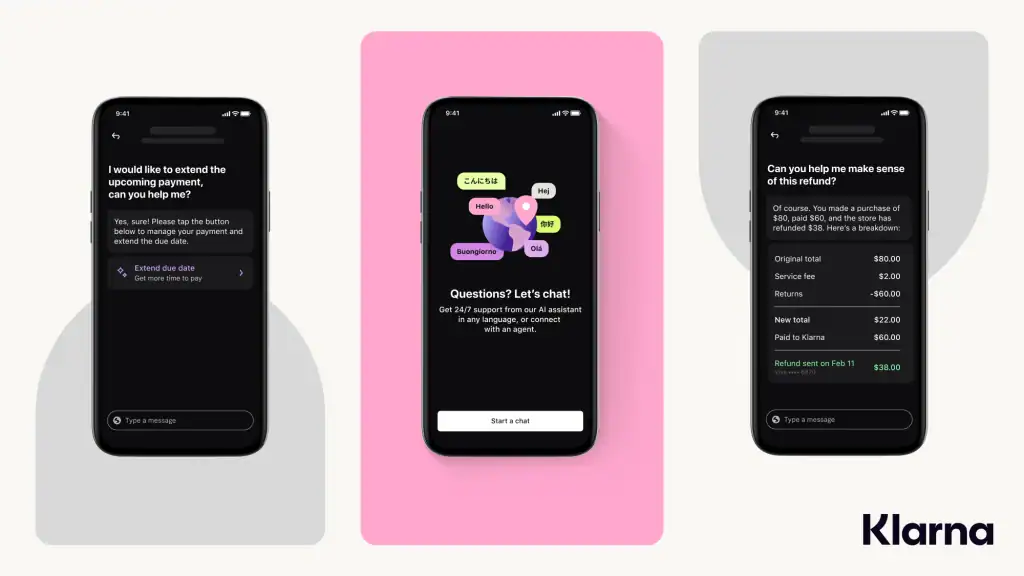
In February 2024, the fintech company Klarna launched an AI assistant for customer service. In its first month, it handled 2.3 million conversations, two-thirds of all customer service chats. Repeat inquiries also dropped 25%, and resolution time fell from 11 minutes to under 2. That drop in repeat inquiries is, in essence, a First Contact Resolution improvement.
However, the story has a second chapter. In 2025, Klarna began hiring people for its customer service team again. According to the company, AI solves the easy issues, while people handle the moments that matter. The assistant still handles two-thirds of inquiries. The lesson is clear: automating volume isn't enough if resolution suffers on complex cases.
AI Agents in Retail: Camping World Went from Hours to Seconds
Camping World, a U.S. retailer of recreational vehicles, added a virtual agent to its customer service. According to IBM, the technology provider, customer engagement increased by 40%. Wait times also dropped from hours to 33 seconds. The case shows the value of availability: customers get answers when they ask, not when the team is free.
Does your AI agent answer, or does it resolve?
At Crombie, we build AI agents integrated with your data and systems, capable of resolving customer inquiries in real time.
First Contact Resolution and AI Customer Service FAQ
The Basics
An AI customer service agent is a system that answers inquiries and takes actions on behalf of a company. Unlike a chatbot with scripted replies, it can query systems, book, reserve, or update data. As a result, it resolves complete cases and escalates to a person only when needed.
FCR stands for First Contact Resolution or first call resolution. In a call center, it measures the percentage of issues resolved on the first contact, with no follow-up calls. Today, the metric applies to every channel, including chat, messaging, and AI agents.
First Contact Resolution measures whether the issue was resolved on first contact. Containment rate, on the other hand, measures whether the conversation ended without escalation to a person. A frustrated customer who abandons the chat counts as contained, but not as resolved. That is why both metrics should be read together.
Because a campaign, a peak season, or a launch can multiply inquiry volume in a short time. If customer service isn't ready, that volume turns into delays, repeat contacts, and lost sales. By contrast, an AI agent prepared in advance absorbs demand and helps turn that growth into sales.
Most often, the team gets overloaded and response times increase. Repeat contacts also grow, because issues aren't resolved the first time. As a result, cost per contact rises and satisfaction drops among new customers.
The autonomous resolution rate is the percentage of issues an AI agent resolves on its own, without human intervention. It is different from total First Contact Resolution, which also includes what people resolve. Measuring them separately shows how much the agent really contributes.
Measuring and Improving FCR with AI Agents
Divide the issues resolved on first contact by the total received, then multiply by 100. With AI agents, you also need to define a repeat-contact window and cross-reference every channel. How you set that window depends on your inquiry types.
According to SQM Group, a total First Contact Resolution rate between 70% and 79% is a good industry standard. However, that figure shouldn't be compared with the agent's autonomous resolution rate. To set realistic goals, measure your current baseline first.
Every unresolved issue generates new conversations that consume processing and cloud capacity. On platforms such as AWS, that consumption shows up on the monthly bill. That is why improving FCR is also a way to optimize infrastructure costs.
Every interaction with an AI agent consumes model tokens. If the customer returns for the same reason, the agent processes the context again, and the consumption repeats. By contrast, a high First Contact Resolution rate reduces repeat conversations and, with them, token spend.
Yes, as long as it is integrated with the systems where those tasks live. For example, it can answer an inquiry and, in the same conversation, book an appointment or update a record. The scope depends on the integrations and the rules each business defines.
Industries with repetitive inquiries and demand peaks benefit most. Examples include real estate, retail, travel, education, and financial services. In every case, the starting point is identifying which inquiries each demand peak generates.
Implementing AI Agents for Customer Service
The cost depends on the number of channels, the systems to integrate, and the actions the agent must perform. Inquiry volume and expected token and infrastructure consumption also matter. To size it for your case, you can schedule a meeting with the Crombie team.
Ask how they measure first contact resolution and whether they separate autonomous resolution from containment rate. Also ask how they integrate the agent with your systems and design the handoff to people. Companies such as Crombie build custom agents with that approach. To evaluate your case, you can schedule a conversation with their team.
The first step in implementing AI customer service is identifying your most frequent inquiries and measuring your current FCR. Then, automate those inquiries first and expand the scope gradually. To define where to start, you can schedule a meeting with the Crombie team.
0 comments
·
14 min Read